

The Blessing That Stayed Raised
- Tio Felipe
- Apr 12
- 4 min read

When the Word Lingers:
Devotional Insights from the Hidden Places of Scripture
They walked with Him as far as Bethany.
Not to a courtroom.
Not to a garden this time.
Not to a tomb.
To a hillside east of Jerusalem, the familiar slope of the Mount of Olives, where so much of the final week had already unfolded. From there the city lay behind them, and the road ahead looked strangely open.
Luke tells the moment with striking calm:
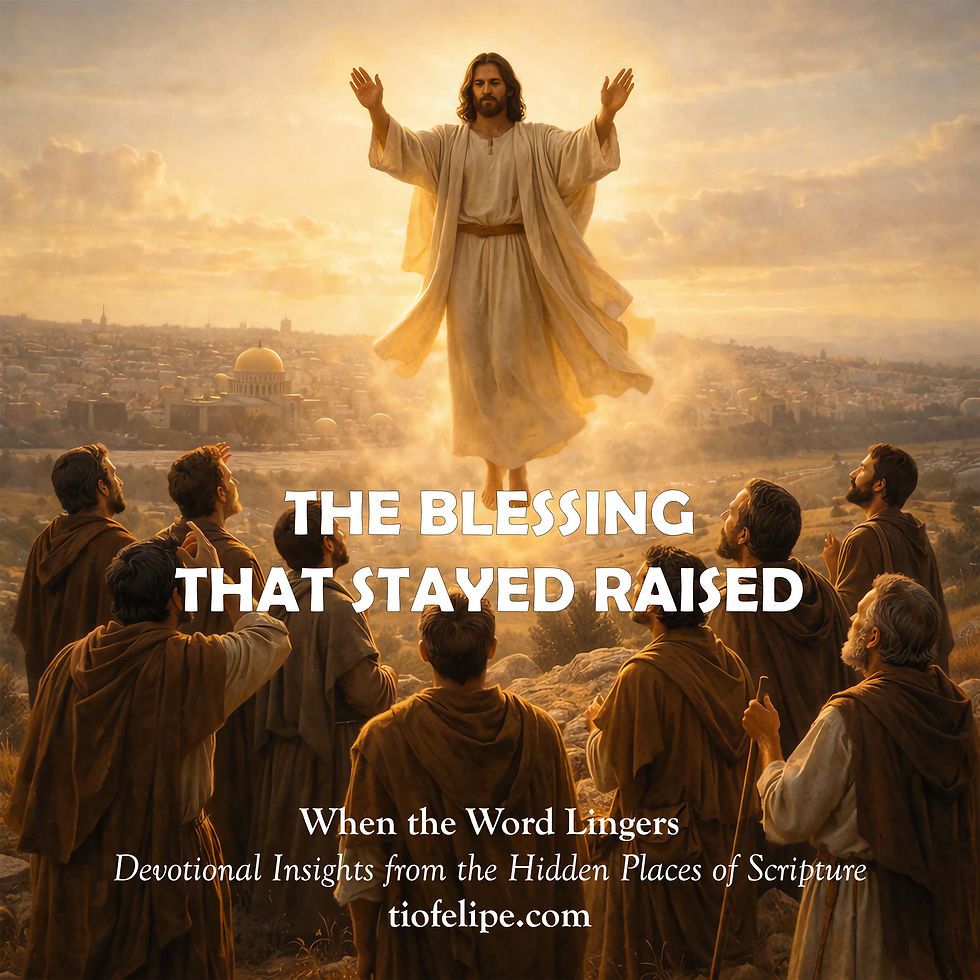
“Then he led them out as far as Bethany, and lifting up his hands he blessed them.”
Luke 24:50
That detail matters.
His hands were raised in blessing.
The last visible posture of Jesus on earth was not warning, not rebuke, not even instruction. It was blessing. The hands once nailed open on the cross were now lifted over His disciples in peace.
And while He blessed them, He departed.
“While he blessed them, he parted from them and was carried up into heaven.”
Luke 24:51
The ascension is often treated as a kind of epilogue — the closing scene after the real drama of death and resurrection. But in Scripture it is not an ending tucked awkwardly onto the story.
It is the enthronement.
The resurrection declared that death had been defeated.
The ascension declared that the risen Christ now reigns.
Acts says it this way:
“As they were looking on, he was lifted up, and a cloud took him out of their sight.”
Acts 1:9
That cloud is not weather. In Scripture, clouds often mark the manifest presence of God — Sinai wrapped in cloud, the Tabernacle filled with cloud, the glory of the Lord descending. Jesus is not merely disappearing upward into the sky. He is being received into divine glory.
The disciples stood watching.
Of course they did.
How could they not? Their eyes had followed Him through Galilee, through the Temple courts, through the cross and the empty tomb. And now they strained upward as the visible Christ passed from sight into heaven’s hidden realm.
Then two men in white stood beside them and asked:
“Men of Galilee, why do you stand looking into heaven?”
Acts 1:11
It sounds almost gentle, almost smiling.
Not because the disciples were wrong to look.
But because they could not remain there.
The ascension does not invite endless staring. It commissions witness.
The messengers continue:
“This Jesus, who was taken up from you into heaven, will come in the same way as you saw him go into heaven.”
Acts 1:11
That is the second great truth of the ascension.
He is not absent in defeat.
He is reigning in promise.
He will return.
The same Jesus.
Not a different savior.
Not a spiritual idea.
The same crucified, risen Lord who blessed them with raised hands.
So why did He ascend at all? Why not remain visibly present, teaching from Jerusalem, walking the roads of Galilee, silencing all doubt forever?
Because the mission was no longer to stay centered around one visible location.
If Jesus remained bodily present in one town, one land, one place, the nations would still have to come to Him there. But by ascending, He would send the Spirit and become present to His people everywhere. His departure would not shrink His presence.
It would multiply it.
That is why He had already told them:
“It is to your advantage that I go away.”
John 16:7
Only by going would the Spirit come in this new covenant fullness. Only by ascending would Christ take His place at the Father’s right hand — the place of authority, priesthood, and intercession.
The ascension means that Jesus is not wandering the earth half-hidden after resurrection. He is enthroned.
The Lamb who was slain now rules.
And yet the scene Luke gives us remains deeply tender. The disciples do not collapse in despair when He leaves. In fact, Luke says something surprising:
“And they worshiped him and returned to Jerusalem with great joy.”
Luke 24:52
Great joy.
That would have been impossible before the resurrection. Earlier departures had meant confusion and fear. Now His leaving produces joy because they finally understand: He is not being taken from them the way death took Him. He is ascending in victory. His blessing remains even as He rises. His departure is not abandonment.
It is assurance.
Luke adds:
“And were continually in the temple blessing God.”
Luke 24:53
Notice the transformation.
The disciples who once hid behind locked doors now stand publicly in the Temple praising God. The ascension has not diminished their courage. It has deepened it. They know where Jesus is. They know what He is doing. They know what comes next.
The hands raised over Bethany are still, in one sense, raised. His blessing does not stop when the cloud receives Him. It continues from heaven. The ascended Christ rules, intercedes, and prepares His people for witness until the day He comes again.
So the final image of the Gospel story is not loss.
It is blessing.
Not disappearance.
But coronation.
Not silence.
But promise.
The disciples watched until they could see Him no longer. Then they turned back toward Jerusalem, not because the story was over, but because it had entered its next great chapter.
The King had taken His throne.
And the world was now waiting for His witnesses — and one day, for His return.


Comments