

Leaves without Fruit
- Tio Felipe
- Mar 31
- 4 min read

When the Word Lingers:
Devotional Insights from the Hidden Places of Scripture
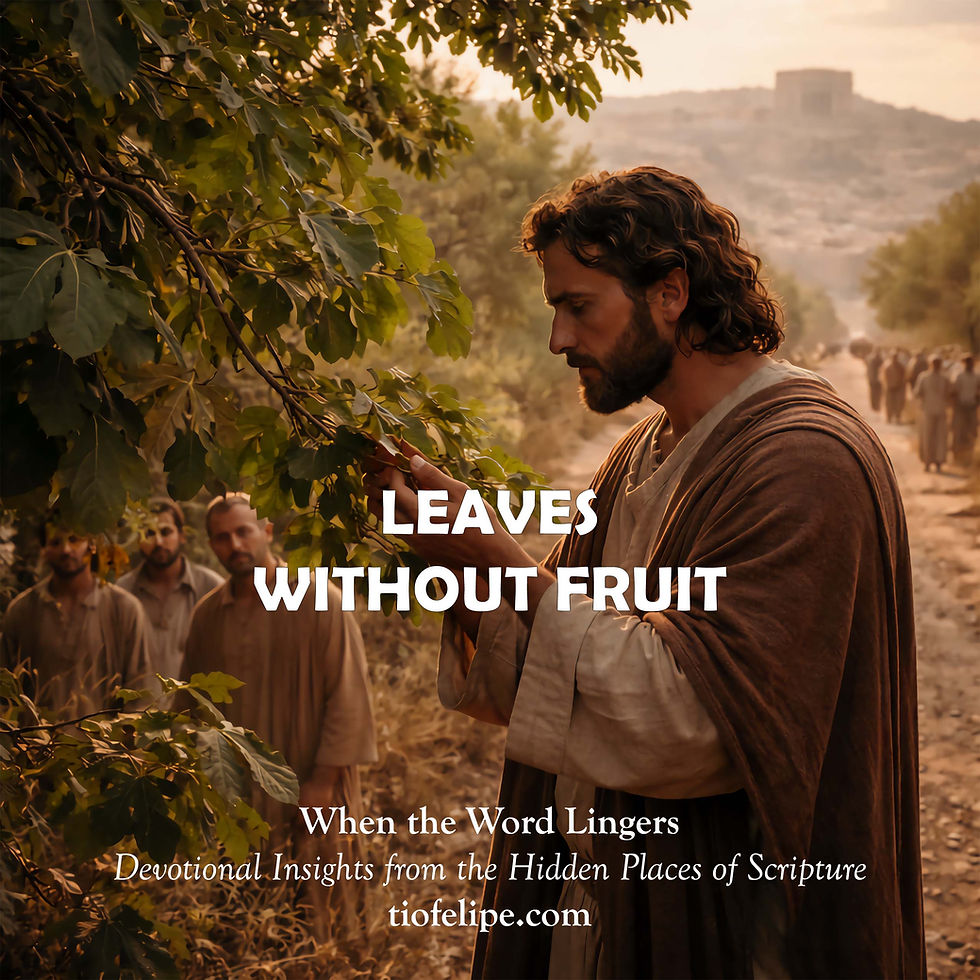
It happened in the morning, on the road back into Jerusalem.
After the shouts of the Triumphal Entry and the force of the Temple cleansing, Jesus returned to the city again. The road ran past fig trees and stone paths, the ordinary edges of a land crowded with pilgrims and tense with expectation.
And there, by the roadside, stood a tree in full leaf.
Mark tells it carefully:
“And seeing in the distance a fig tree in leaf, he went to see if he could find anything on it.”
Mark 11:13
At first the scene feels small, almost strange. Why would Jesus approach a tree looking for fruit, and why does it matter that He found none?
Because in that land, leaves promised something.
Fig trees often produced early edible buds before the full crop matured. A tree clothed in leaves advertised life. It suggested nourishment, readiness, possibility. Yet when Jesus came close, there was nothing there.
“He found nothing but leaves.”
Mark 11:13
Then He spoke:
“May no one ever eat fruit from you again.”
Mark 11:14
Matthew shortens the account and shows the effect immediately:
“And the fig tree withered at once.”
Matthew 21:19
This was not irritation over breakfast.
It was a living parable.
The fig tree stood for something larger — a visible display of life without the reality of fruit. In the Old Testament, Israel is often pictured as a vine or fig tree, a people meant to bear fruit before God. The prophets had long warned against the appearance of covenant faithfulness without justice, mercy, or repentance.
Jesus was not condemning botany.
He was exposing a nation’s spiritual condition.
That becomes unmistakable when the story is read beside what follows. He enters the Temple again, and there the chief priests and elders confront Him:
“By what authority are you doing these things, and who gave you this authority?”
Matthew 21:23
That question sounds like a search for truth, but it is actually a defense of control. They had already seen enough to know that Jesus carried extraordinary authority. The cleansing of the Temple, the healings, the crowds, the prophetic force of His actions — all of it stood before them. The issue was not lack of evidence.
It was unwillingness to yield.
Jesus answered them with a question of His own:
“The baptism of John, from where did it come? From heaven or from man?”
Matthew 21:25
That question exposed them the way the fig tree had exposed the Temple.
If they said John’s baptism was from heaven, they would have to explain why they had rejected his witness about Jesus. If they said it was from man, they would lose credibility with the crowd, who believed John was a prophet.
So they chose the safest answer:
“We do not know.”
Matthew 21:27
That reply revealed the truth.
They did know enough to act honestly.
They simply did not want the consequences of honesty.
The fig tree had leaves without fruit.
The leaders had religion without surrender.
That is why these scenes belong together. On the roadside, Jesus judges the tree. In the Temple, He exposes the same emptiness in Israel’s leadership. Outwardly, there was abundance — priests, sacrifices, liturgy, crowds, debate, authority structures. Inwardly, when the Messiah stood before them, there was no fruit of repentance, no recognition, no yielded heart.
The tree advertised what it did not possess.
So did the system confronting Him.
This is what makes the story so piercing. Jesus is not impressed by religious foliage. He does not mistake activity for fruit, vocabulary for obedience, or structure for life. He comes close enough to inspect what looks alive.
And closeness reveals truth.
Mark says the disciples noticed the tree the next day:
“Rabbi, look! The fig tree that you cursed has withered.”
Mark 11:21
The withering was visible, but the deeper warning was aimed at people, not plants. A life, a temple, or a nation may look full from a distance. Leaves can be impressive. But if there is no fruit when God draws near, the appearance itself becomes part of the judgment.
And yet Jesus does not only warn. He also teaches.
“Have faith in God.”
Mark 11:22
Not faith in appearances.
Not faith in institutions.
Not faith in leaves.
Faith in God.
Because real fruit never grows from performance. It grows from dependence. The leaders guarded their place. Jesus called for trust. The tree offered show. Jesus sought substance.
So the road, the tree, and the Temple all preach the same message:
God does not come merely looking for leaves.
He comes looking for fruit.


Comments